I read a book about the diamond trade (called Precious Objects), and one of the men featured wore a necklace with the letters TCB on it, an acronym for Taking Care of Business.
I want one.
I've been taking care of A LOT of business, since my return to Houston. I've been organizing like a ninja (ninjas are very organized, in case you didn't know), unpacking bags from my 3-week sojourn in Dallas, and restocking the old pantry with everything I could possibly need for the upcoming semester.
I also notified the office of my apartment complex about a sizable rat inhabiting a hidey-hole in the breeze way.
But I digress.
By the end of the week, I plan to have made gluten-free bison meatloaf to freeze, spaghetti sauce, and spaghetti squash (also to freeze). My unusable/broken scanner will be taken to a recycling facility, and the faded clothes I no longer wear will find their way to a Goodwill drop-off station. My apartment will be sparkling clean, from top to bottom, and my allergies will probably be raging as a result.
I will start this semester off properly. I will be ready for anything the professors throw at me.
No, really. I will.
Tuesday, January 10, 2012

Wednesday, January 4, 2012
The Finkler Question, by Howard Jacobson
 The Finkler Question is yet another book from The Economist's Best Books of 2011 issue. The back cover describes it as "a funny, furious, unflinching story of friendship and loss, exclusion and belonging, and of the wisdom and humanity of maturity."
Pretty well sums it up, even if it doesn't exactly go into particulars in any way, shape, or form.
A few things to note, if you care to rush out and buy The Finkler Question: it deals extensively with the conflict between Palestinians and the Israeli government. I already had a pretty set idea of my beliefs, in regards that conflict, and they're not fundamentally changed after reading the book, but it definitely gives pause for thought.
Barnes & Noble Review warns that the book "will probably distress you on its way to disarming you." The story deals with modern Jews living in England, and their perception of events and issues shaping the Palestinian conflict, as well as the views of other countries. Secular and religious Jews face off, and there is even a case of a "hate crime" committed by one Jew against another.
The Finkler Question discusses the conflict in intensely humanizing and personal ways, and though it is at the heart of the story, it is only one of the topics addressed. The universal need for love and acceptance and belonging, the battle against the personal history that shapes each and every human being, and the failings of friends as new interests arise all confront the reader throughout the engrossing novel.
I definitely recommend it.
Monday, January 2, 2012
The Forgotten Waltz: A Novel, by Anne Enright
 One of my favorite editions of The Economist each year is their summary of best books of the year. This year, I picked out the titles I thought sounded most promising and duly created a list on my iPhone so I could be prepared when I next embarked on a book buying binge.
Unwilling to wait for books to arrive in the mail (and having been tipped off by my mom that I would be receiving gobs of books for Christmas), I went to the book store. Of the twelve books I noted in my digital list, Barnes & Noble had exactly three in stock. That's three books out of the multitudes of books declared as "must reads" by one of the most respected news magazines in the world.
Three.
3.
The manager looked none too pleased when I commented on the fact (but then, I don't believe he knew what The Economist was, as he assumed a puzzled expression, so...).
The two books I decided to buy were The Forgotten Waltz by Anne Enright and The Finkler Question by Howard Jacobson.
Today, we will address The Forgotten Waltz.
I like Ms. Enright's style of writing. I will say that much. It is spare, and intriguing - mostly because the paucity of detail leaves the reader wondering about certain events that go unremarked... unless I just forgot about them - and in its austerity is beautiful.
The story, however, left me a bit cold.
I wanted to like the book so very much. Really, I did.
The heroine is described as "flawed and unforgettable" on the book jacket, which might lead the reader to think that she will be someone you empathize with, whose choices you support.
Hmmm...
My main issue with the character and her love interest (a different person from her husband, natch), is that they don't try to address the problems in their current marriages (yup: double adultery), but instead have an affair, heedless of the damage it might do to the other people involved, particularly her love interest's adolescent daughter.
Most of the novel - told from the main characters point of view - is spent trying to justify herself to the reader, her family, her friends; trying to convince us that she had no choice but to have an affair.
I'm not a close-minded person, where extramarital relations are concerned. I can see where an extramarital affair might be justifiable, or at least understandable. In this case, however, the affair seems unnecessary.
Granted, there is some satisfaction at the end of the book, when the heroine is trying to make herself seem less of a house-wrecking witch in the eyes of her lover's child. She points out that "it was going to happen one way or another. I mean it could have been anyone [breaking up your parents' marriage.]" To which the child answers truthfully, "But it wasn't... It was you."
At least, in the final exchange of words between home-wrecker and home-wrecked, the heroine is not able to escape from her culpability. Small relief.
(Also, I couldn't figure out why the book was entitled The Forgotten Waltz. Maybe I just missed something. It's probable. But the title seems unrelated to the events, seeing as not much of the heroine's affair is forgotten, and there is very little waltzing (as in, none) in the book itself.)
There are books I keep forever, and books I give away or sell on to used book stores.
This one will go to Half Price Books sometime in the very near future.
Friday, December 30, 2011
The Holidays Can Be Rough
At this time, 14 years ago, I was busy helping my Christmas gift adjust to life in his new household. I was 15 years old, and I'd wanted a dog for years. My parents struck me a bargain: if I helped build a new backyard fence, I could get a dog for Christmas. I duly bought all the books you could imagine on dog breeds, and eventually settled on a labrador retriever.
On Dec. 23, 1997, I found the dog who would become Major Tom Shadowmaker amongst a rambunctious pile of puppies just outside of Henrietta, Texas. He was purebred from a line of champion hunters, and his breeder was visibly upset when he learned that my dog - as yet unnamed - would not be raised to hunt. He saw how much I adored the dog, however, and so I took him home with me.
I felt incredibly guilty as I held the puppy in my lap for the two hour drive back home. I didn't feel guilty because my puppy wouldn't be raised a hunter, though, but because none of the names I'd previously thought of for him seemed to suit. I had thought of Asta (after Nick and Nora's dog), and Tree (I hoped to condition him to bark when called). Neither of the names fit the bundle of black fur in my lap, however, and I felt awful.
My father, who had taken me on the trek to find my Christmas gift, kindly allowed me to control the radio, and while we listened, the Peter Schilling song "Starship to Major Tom" came on. I looked at the puppy, and decided that he looked like a Major Tom. And thus World War I's noblest flying ace was born.
The name Shadowmaker came from his parents: Blackshadow and Widowmaker.
I spent the first three nights sleeping on the floor with Major Tom (known around the house simply as Major, or when in trouble, Young Man). After a while, he became accustomed to sleeping on his bed in the corner of my bedroom, and there he stayed for the next three years.
When I was 17, I was diagnosed with leukemia, and was thereafter home-schooled because my immune system was too weak to allow me to go to school. Major Tom was at home with me every day. As soon as I got sick, he seemed to sense that something was wrong, and his boisterous puppy days ended. He calmed down, and followed me around the house or, when I was in bed recovering from chemotherapy, sat alertly by my bed, watching to make sure I was okay.
I left for college at the age of 18, but Major stayed behind with my parents. I visited every weekend, and played with him and loved him as much as I could. He never failed to wag his tail when I came home, to leap into the air to show his happiness at my return, and it stung my heart every time he realized I was leaving again.
When I moved into an apartment complex that allowed large dogs, I tried to take Major with me. After a few fraught hours, during which he marked practically everything I owned and never ceased hyperventilating, despite sedation, I took him home to my parents, where he calmed down. Apparently, labs don't like change in their environment (which we rediscovered every time my parents rearranged their living room furniture).
Until Major was about 12 years old, he constantly amazed people with how youthful and energetic he was (I chalk this up to our allowing him to lick our ice cream bowls, but I could be wrong). When I took him to a new vet for the first time and informed the vet tech that Major was 12 years old, the tech looked at me and asked, "Are you sure?" A quick glance at Major's medical history reassured him, at which point he announced that Major was the healthiest, most energetic 12 year old dog he'd ever seen.
After that visit, however, Major began to go downhill, healthwise. He developed a series of fatty tumors, one of which couldn't be surgically removed because of its location, and that eventually grew to impede his movement in the last months of his life. He developed arthritis in his back hips from all of that jumping as a puppy, and he sounded, my mother said, like an obscene phone caller when he got excited, breathing heavily, raspily for several minutes after a new person arrived.
I came home for Christmas, this year, knowing that Major Tom wasn't long for this world. He could hardly walk, and he'd lost a lot of weight. Too much weight. I could see his ribs for the first time since his youthful days as a lean, mean, leaping machine. He had also lost control of himself, and we could no longer control him, either: deaf and blind, he would run off if we let him into the front yard, something he hadn't done for years.
He was constantly in pain, and it showed. So, after 14 years of companionship from the gentlest dog I've ever encountered, from the most loving animal I've ever met, I had to put him down.
I spent a long time, the evening before it happened, telling him how much I loved him, how much I would miss him, and what a wonderful dog he was. I told him about where he was going: a place where he could have whole bowls of ice cream, instead of just the dregs, and could run and swim, and wouldn't hurt any more.
My parents and I took him to the vet on December 21, 2011, and we stayed with him while the fatal dose of anesthesia was administered; I didn't want him to be alone, with people he didn't know, when he died.
Prior to that, while he lay sedated on the floor next to the examination table, I crouched next to him and told him I loved him, and what a good dog he'd been. I told him how special he was to me, and that he was the best dog there ever was. It was 13 years and 363 days since he'd first entered my life as a muddy, face-licking puppy.
Now, I catch myself doing things I did for years for Major Tom's benefit: leaving the door to my bedroom open so he can come in during the night time if he wants to, or feeling guilty about leaving the house for the afternoon, because he'll be alone. And then I remember that he's not here. I still expect to see him, lying in his observationally advantageous position in the corner of the living room - where the carpet is stained from his constant habitation.
But I'll never see him again. And it hurts.
I miss you, Major Tom Shadowmaker.

On Dec. 23, 1997, I found the dog who would become Major Tom Shadowmaker amongst a rambunctious pile of puppies just outside of Henrietta, Texas. He was purebred from a line of champion hunters, and his breeder was visibly upset when he learned that my dog - as yet unnamed - would not be raised to hunt. He saw how much I adored the dog, however, and so I took him home with me.
I felt incredibly guilty as I held the puppy in my lap for the two hour drive back home. I didn't feel guilty because my puppy wouldn't be raised a hunter, though, but because none of the names I'd previously thought of for him seemed to suit. I had thought of Asta (after Nick and Nora's dog), and Tree (I hoped to condition him to bark when called). Neither of the names fit the bundle of black fur in my lap, however, and I felt awful.
My father, who had taken me on the trek to find my Christmas gift, kindly allowed me to control the radio, and while we listened, the Peter Schilling song "Starship to Major Tom" came on. I looked at the puppy, and decided that he looked like a Major Tom. And thus World War I's noblest flying ace was born.
The name Shadowmaker came from his parents: Blackshadow and Widowmaker.
I spent the first three nights sleeping on the floor with Major Tom (known around the house simply as Major, or when in trouble, Young Man). After a while, he became accustomed to sleeping on his bed in the corner of my bedroom, and there he stayed for the next three years.
When I was 17, I was diagnosed with leukemia, and was thereafter home-schooled because my immune system was too weak to allow me to go to school. Major Tom was at home with me every day. As soon as I got sick, he seemed to sense that something was wrong, and his boisterous puppy days ended. He calmed down, and followed me around the house or, when I was in bed recovering from chemotherapy, sat alertly by my bed, watching to make sure I was okay.
I left for college at the age of 18, but Major stayed behind with my parents. I visited every weekend, and played with him and loved him as much as I could. He never failed to wag his tail when I came home, to leap into the air to show his happiness at my return, and it stung my heart every time he realized I was leaving again.
When I moved into an apartment complex that allowed large dogs, I tried to take Major with me. After a few fraught hours, during which he marked practically everything I owned and never ceased hyperventilating, despite sedation, I took him home to my parents, where he calmed down. Apparently, labs don't like change in their environment (which we rediscovered every time my parents rearranged their living room furniture).
Until Major was about 12 years old, he constantly amazed people with how youthful and energetic he was (I chalk this up to our allowing him to lick our ice cream bowls, but I could be wrong). When I took him to a new vet for the first time and informed the vet tech that Major was 12 years old, the tech looked at me and asked, "Are you sure?" A quick glance at Major's medical history reassured him, at which point he announced that Major was the healthiest, most energetic 12 year old dog he'd ever seen.
After that visit, however, Major began to go downhill, healthwise. He developed a series of fatty tumors, one of which couldn't be surgically removed because of its location, and that eventually grew to impede his movement in the last months of his life. He developed arthritis in his back hips from all of that jumping as a puppy, and he sounded, my mother said, like an obscene phone caller when he got excited, breathing heavily, raspily for several minutes after a new person arrived.
I came home for Christmas, this year, knowing that Major Tom wasn't long for this world. He could hardly walk, and he'd lost a lot of weight. Too much weight. I could see his ribs for the first time since his youthful days as a lean, mean, leaping machine. He had also lost control of himself, and we could no longer control him, either: deaf and blind, he would run off if we let him into the front yard, something he hadn't done for years.
He was constantly in pain, and it showed. So, after 14 years of companionship from the gentlest dog I've ever encountered, from the most loving animal I've ever met, I had to put him down.
I spent a long time, the evening before it happened, telling him how much I loved him, how much I would miss him, and what a wonderful dog he was. I told him about where he was going: a place where he could have whole bowls of ice cream, instead of just the dregs, and could run and swim, and wouldn't hurt any more.
My parents and I took him to the vet on December 21, 2011, and we stayed with him while the fatal dose of anesthesia was administered; I didn't want him to be alone, with people he didn't know, when he died.
Prior to that, while he lay sedated on the floor next to the examination table, I crouched next to him and told him I loved him, and what a good dog he'd been. I told him how special he was to me, and that he was the best dog there ever was. It was 13 years and 363 days since he'd first entered my life as a muddy, face-licking puppy.
Now, I catch myself doing things I did for years for Major Tom's benefit: leaving the door to my bedroom open so he can come in during the night time if he wants to, or feeling guilty about leaving the house for the afternoon, because he'll be alone. And then I remember that he's not here. I still expect to see him, lying in his observationally advantageous position in the corner of the living room - where the carpet is stained from his constant habitation.
But I'll never see him again. And it hurts.
I miss you, Major Tom Shadowmaker.

Sunday, December 11, 2011
"The Marriage Plot" by Jeffrey Eugenides
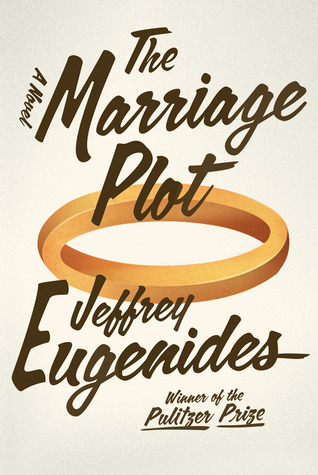 "The Marriage Plot": that timeless literary tale, most often related by Elizabeth Gaskell, Jane Austen, George Eliot, and the Brontes, in which a young woman needs/wants to be married in order to be happy, but is prevented for one reason or another.
The premise of The Marriage Plot by Jeffrey Eugenides (Pulitzer winner for Middlesex), revolves around the seemingly antiquated plotline so idolized by women.
The story takes place at Brown University, where the heroine, Madeleine, is pursued (to no avail) by a frowsily dapper religious scholar while she pursues a relationship with a one-time collegiate playboy, Leonard. The playboy also has bipolar disorder, aka manic depression.
Whereas in Austen or Gaskell, social class or financial abilities kept lovers apart, in this case, it is Leonard's mental illness that prevents their happiness.
The Marriage Plot explores ground most often covered in hot-pink chick-lit books with smarmy-looking skeletons in Manolos on the cover. Obviously, as the understated white and black cover attests, Eugenides' treatment is vastly superior. The ground covered, to spell it out, is the creation of "the friend zone" by modern females - characterizing male friends as asexual or non-romantic, and suffered by uber-religious Mitchell - and the relationship conflicts created by living with a person of the opposite sex to whom you are not married.
As with Middlesex, Eugenides places the reader into the mind of a character who has a disorder with which we are (most likely) not personally acquainted. Calliope, the main character in Middlesex, had a rare genetic mutation that meant she/he was a male without external sex organs, and the story covers how she/he came to be born with the mutation, how it was discovered, and how Calliope eventually chose to cope with it.
In the case of The Marriage Plot, the reader experiences Leonard's manic swings, his all-consuming depression, and his battle with mood-altering/stabilizing drugs, in this case lithium. As with the characters in the book, each crescendoing burst of energy on Leonard's part leaves us wondering how it will affect his life, and the lives of those around him.
The Marriage Plot wasn't what I would call an "easy read," but then Middlesex wasn't particularly easy, in many parts. This latest offering from Eugenides is less fantastical than his two previous offerings, but he seems to be mellowing as his writing progresses.
That being said, I have to confess that I prefer Middlesex - one of my all-time favorite reads - over The Marriage Plot. Get ready for the over-used word, again. The Marriage Plot just wasn't as compelling as the other books I've read lately (I'm in the midst of The English Patient, as we speak - er - type).
Wednesday, November 30, 2011
"The Cat's Table" by Michael Ondaatje
I have not read The English Patient, but it should arrive in a couple of days, so I guess I'll just have to be patient (wah-wah). My mother, however, in a wonderful act of literary enablement purchased two books for me about a month ago.
Studio is over. I have one final exam. Let the reading begin!!!!!
Yesterday (Tuesday, Nov. 29), I had a migraine, most likely caused by a serious lack of quality sleep prior to my final project submission in studio and the sudden draining of adrenaline from my system, ditto. I stayed in bed all day and subsisted on gluten-free blueberry waffles and Greek yogurt and hot chocolate.
And I read, Dear Reader! Oh! How I read!
I read Michael Ondaatje's The Cat's Table, which has been sitting on my bookshelf for weeks, beckoning me with its come-hither book-jacket, seducing me with the promise of what lay hidden beneath said book-jacket, and occasionally falling to the floor in a pathetic bid for attention. After playing hard to get, I finally succumbed to its promises, yesterday.
And promptly read the whole thing.
As expected from a Booker Prize winner, The Cat's Table is beautifully written and (I'm getting ready to use one of my most over-used words, here) compelling. I couldn't put it down. It is, in fact, the reason I took a bath, yesterday, in lieu of a shower: it's difficult to read in the shower, but oh so easy in the bathtub.
I sacrificed hair hygiene for a book! That is not a common occurrence.
The story follows a young boy (Michael) and two other boys who are traveling alone from present-day Sri Lanka to England. They get into all sorts of trouble, on board, and are charmed by the other passengers assigned to sit at the dinner table of least prominence in the dining hall, also know as the Cat's Table.
Over the course of the journey, the reader discovers that the people on board are not what they appear to be: the lonely old (not so old) spinster is most likely an agent for MI5, and the kindly botanist who has a crush on Michael's cousin smokes pot in the hold of the ship. There is a prisoner, on board, who the boys observe secretly when he comes out from the hold at night for his daily walk above-deck, dressed in leg-irons and manacles to prevent the criminal from escaping.
The effects of the journey stay with Michael, later in life, and the story is told from his vantage point as a grown man with one failed marriage behind him, who still clings to the idealized person of his older female cousin, Emily, who perhaps had the greatest secret of everyone on board.
I recommend it. Highly.
On the strength of its impression on me, I even ordered The English Patient (also written by Ondaatje, and winner of the Booker Prize). It should be here in a couple of days, by which point I'll have worked my way through Eugenides' The Marriage Plot, which I'm also enjoying. I'll give a review of it, after it's finished.
Studio is over. I have one final exam. Let the reading begin!!!!!
Yesterday (Tuesday, Nov. 29), I had a migraine, most likely caused by a serious lack of quality sleep prior to my final project submission in studio and the sudden draining of adrenaline from my system, ditto. I stayed in bed all day and subsisted on gluten-free blueberry waffles and Greek yogurt and hot chocolate.
And I read, Dear Reader! Oh! How I read!
I read Michael Ondaatje's The Cat's Table, which has been sitting on my bookshelf for weeks, beckoning me with its come-hither book-jacket, seducing me with the promise of what lay hidden beneath said book-jacket, and occasionally falling to the floor in a pathetic bid for attention. After playing hard to get, I finally succumbed to its promises, yesterday.
And promptly read the whole thing.
As expected from a Booker Prize winner, The Cat's Table is beautifully written and (I'm getting ready to use one of my most over-used words, here) compelling. I couldn't put it down. It is, in fact, the reason I took a bath, yesterday, in lieu of a shower: it's difficult to read in the shower, but oh so easy in the bathtub.
I sacrificed hair hygiene for a book! That is not a common occurrence.
The story follows a young boy (Michael) and two other boys who are traveling alone from present-day Sri Lanka to England. They get into all sorts of trouble, on board, and are charmed by the other passengers assigned to sit at the dinner table of least prominence in the dining hall, also know as the Cat's Table.
Over the course of the journey, the reader discovers that the people on board are not what they appear to be: the lonely old (not so old) spinster is most likely an agent for MI5, and the kindly botanist who has a crush on Michael's cousin smokes pot in the hold of the ship. There is a prisoner, on board, who the boys observe secretly when he comes out from the hold at night for his daily walk above-deck, dressed in leg-irons and manacles to prevent the criminal from escaping.
The effects of the journey stay with Michael, later in life, and the story is told from his vantage point as a grown man with one failed marriage behind him, who still clings to the idealized person of his older female cousin, Emily, who perhaps had the greatest secret of everyone on board.
I recommend it. Highly.
On the strength of its impression on me, I even ordered The English Patient (also written by Ondaatje, and winner of the Booker Prize). It should be here in a couple of days, by which point I'll have worked my way through Eugenides' The Marriage Plot, which I'm also enjoying. I'll give a review of it, after it's finished.
Tuesday, November 15, 2011
Bad blogger! Bad! Bad blogger!
 As I cower in the corner after that chastising, I'm coming up with a bazillion-willion-Brazilian excuses for why I haven't written in almost a month.
The main one is this: I'm doing this thing called "grad school" which is like having two full-time jobs, so there's very little time or energy left for blogging.
School is going well, however, as we near the end of the semester. Granted, my life is about to become insanely busy, but that can't be helped. "Pencils down" on our semester design studio projects is at midnight on Nov. 27, so until then, I will be in ohmygodIhavesomuchtodoIthinkI'mgoingtodie mode. My studio-mates and I recently began joking (sort of) about injuring each other so we could maybe have more time to finish the projects (or at least have an excuse for not finishing).
Other than the fact that I will have no life outside of school until Nov. 28 at 5:00 pm, things are going well. My migraines are still pretty rare, I have been approved for health insurance through the Texas Health Pool insurance program (!), and I ordered the new iPhone 4s, which should arrive today, along with its attendant accessories and a 6-pack of socks I ordered from Amazon.
Shine on, you crazy diamond.
On the downside, that health insurance costs $600 per month, I owe Dr. Pain $1,738.33 for Botox injections, and I was in a fender-bender last Wednesday while sitting in line to get iced tea at Chik-Fil-A. I only just reported the accident, today, though, because I've been so stressed out about other things. Monday morning, I'll have the (incredibly minor) damage assessed at a local car dealership to see how much it will cost to fix it, and to discuss what should happen if hairline cracks appear after a couple of months, because that happened in another little wreck I was in years ago, when I didn't see any damage initially.
I have learned my lesson, dear reader.
Now, if you'll excuse me, I have gobs of work to do, designing an underground research facility in Death Valley so I'll be able to turn it into a physical model by Nov. 27, at midnight.
Subscribe to:
Posts (Atom)